
Blog
Avimor ORIGIN Story

January 2, 2026
Avimor ORIGIN Story
By Jennifer Husmann
In the late 1880’s, long before Colin McLeod got off the train in Caldwell, a single wagon appeared in the clearing opening southward from what is today Howell Event Center in Avimor.
Eliza Howell and her family had taken the Oregon Short Line from Ogden, and likely disembarked at Kuna to begin a new life in the hills of Avimor. She was born in 1859 to a prominent Mormon family of Utah, and met her husband William, a native of New York, when he was working the Union Pacific Railway. Eliza and William raised four daughters here on Spring Creek, residing here for nearly two decades, from about 1893-1911.
Like Colin McLeod, Eliza and Wiliam came to Idaho young and penniless, but built generational wealth and social standing off little more than a homestead claim and ingenuity. In 1911 they relocated their ranching headquarters to Weiser, and their residence to the affluent Warm Springs Historic District near downtown Boise where their handsome estate still stands at 1250 Warm Springs Avenue. It is listed on the National Register of Historic places.
Obscurity surrounds the years Eliza spent here in the farmhouse on Spring Creek: land records and newspaper clippings are the chief evidence. They show the birth of a child, the 1893 creation of a US Post Office here in Idaho with Mrs. Eliza Howell listed as postmistress. There’s also a newspaper clipping thanking the community for its support during the fatal illness of their toddler, Ida Howell–as poignant as it was brief.
A yellow and crumbling map recording the small settlement of Howell where Idaho 55 now bisects the county line gives structure and meaning to the most compelling traces of Eliza’s story: the white farmhouse and the red barn gracing the small stream and quiet valley in the heart of Avimor.
Why did William select this particular clearing in the hills for his wife and daughters to make their home?
Today, Spring Creek flanks a hiking trail enjoyed by everyone from Avimor residents to Idaho Novus school children and Eagle day-hikers. The pioneers treasured its clear, cold waters as both a source of hydration, and a rustic thoroughfare. Eons of trickling through the Boise Mountains cut a functional yet beautiful path among the green and granite: Spring Creek Trail was used first by Shoshone and Bannock tribes, then by French fur-trappers, and countless early Idaho pioneers. Later Spring Creek trail evolved into a convenient leg of the crucial stage route from Boise City to Horseshoe Bend, the latter being a gateway to the lucrative and gold-rich Boise Basin. Eliza and William registered their little settlement as a post office in 1893, and William’s own pen reveals that at that time it would serve 100 residents from the surrounding area.
Staking a claim along a busy stage route meant prosperity for the growing Howell family. Chinese miners, Shoshone braves, immigrant farmers, and federal surveyors from the east, all passed by Eliza’s kitchen window on their way to conduct business, stake a claim, settle bitter disputes, or just to provide dinner for their families. These men would need a change of horses and a hot meal by the time they reached Eliza’s front porch, and welcomed a rest stop along the lengthy, 23-mile route from Boise City to Horseshoe Bend.
Raising sheep and providing accommodations to passers-by provided a stable and pleasant livelihood for Eliza’s girls, and the constant traffic along the stage route probably meant quite a bit of excitement.
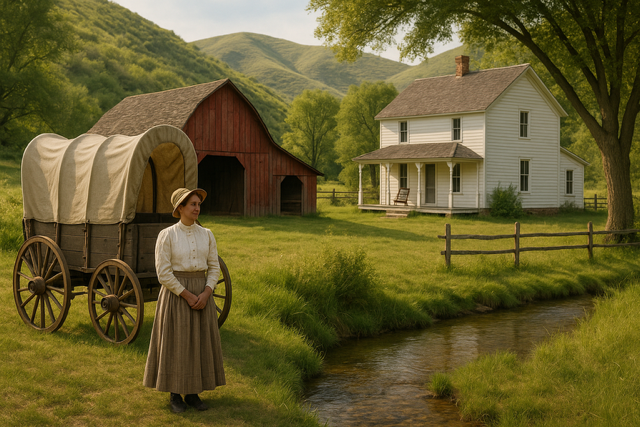
This is Eliza’s story.
Part 1
October 9, 1879
Ogden, Utah
Married! – and not yet 20. My handsome husband and I just returned from the chapel to our home on Franklin Street. How comfortable and charming is my new home–a home of my very own! My dear William is 26 and has traveled all over this Western Frontier! Daddy and Mother came straight to Ogden when they first started west, but my dear husband explored Montana, Wyoming and Idaho Territory with his trains and his guns. What a lucky girl I am to be the wife of a railway man!
December 26, 1882
Ogden, Utah
Baby is so precious. How I love to be the mama of such a big healthy baby girl. She wears her little bonnet at Sunday service so proudly– she seems much older than one year. Yesterday was Christmas and Mother and Daddy came over for dinner. I made a goose and Mother brought the pudding and the light biscuits. We had canned oysters brought in from Salt Lake City and– imagine this– bright, beautiful oranges from San Francisco. My dear husband is so kind to buy such delicacies for little Grace and me! How dear is our happy home here on busy Franklin Avenue!
January 1, 1886
Ogden, Utah
A brand-new year and two little daughters to call my own! We have many sweet moments in our daily lives in our little town. But William told me today he is looking at an opportunity for discounted land directly from the government, north of here in wild Idaho Territory. He said we can get a lot of free land, as long as we raise a good crop there in five years. He said that Grace and Ida will be able to breathe the nice fresh air and see the baby lambs being born every Spring. I just hope the stores and churches in Idaho territory are as nice as here in Ogden. Baby loves her little ribbons and bonnets, and Grace is now nearly four– she’ll be going to school soon! She will be so sweet skipping with the lambs to school, just like Mary in the nursery rhyme. I will miss Mother and Daddy terribly, but I am sure they’ll visit. Boise City isn’t that far away, is it?
May 3, 1887
Pocatello, Idaho Territory
Grace, Ida, Mary and I are at the depot while William gets our bags from the luggage man so we can take the next train to Kuna. Idaho Territory seems nice so far. Some of the church members settled near here and I think the people at the train depot seem friendly. But I am wondering how William will raise sheep here with all these rocks and dust? The only water source I’ve seen is the Snake River, and I can understand why they named it after such a disagreeable creature. Many drownings have taken place in its fierce waters, the conductor man told us as we were disembarking. Will my home be on this frightening river, among these ancient rock formations and dusty sage? What about the little white church and steeple, the store with the pretty ribbons and fabric, the town square? Oh I hope what lies ahead is not like Pocatello!
May 20, 1887
North of Boise City, Idaho Territory
Home Sweet Home! I knew William would come through! We got off the train at Kuna, which was tidy enough for a whistle-stop junction, and our freight wagon bumped along the twisted stage route to Boise City and then headed north through the hills to our homestead. What a splendid site for our new home! William got to work raising a little shanty for us right away, and he is bringing in some old French trappers to help us dig a well. The weather is splendid now, but we know winter will be here soon, and before long our little creek will run dry. For now, the cheerful little creek is enchanting in its bubbling and frothy course. Little Gracie already waded in, her happy little feet so relieved after that dusty and bumpy wagon ride! No churches or town squares in sight here, but I really don’t miss them. These wildflowers, green hills and the little brook will be enough for Gracie, Ida, baby, and me!
Easter Sunday 1888
North of Boise City, Idaho Territory
Easter feels very different here in Idaho Territory than back in Ogden, that’s for certain. I asked William where we’d be attending Easter services and he said the closest church was Horseshoe Bend, nine miles north of us. What a strange life this is here on the frontier! Our only news comes by way of our visitors from along the stage line. Last week an interesting gentleman rode in, on his way to Ola to see about some granite he said was ripe there now. He is an old bachelor and calls himself Con the Packer. He brought us a newspaper from early March, and it was tremendously fun to read the happenings from Boise, even though the news is nearly 2 months old! At first William was worried about him; he said that horse thieves are a possibility in these hills. When he leaves to check on the flocks he always leaves a rifle lying across two machine cut nails above the door.
But Old Con ended up being harmless and has actually become a great friend. He helped Wiliam repair the back fence before he took off this afternoon for Horseshoe Bend. We had a kind of Easter dinner with our guest: William shot a jackrabbit in the hills on Saturday, and I made a stuffing and some of the potatoes left from last years’ harvest. Potatoes grow very well here, and they last a long time in the little make-shift cellar William was able to dig beneath the main house, which isn’t finished yet. It's coming along just fine: French Joe and Port-man-teux come by every day and help William and me. They are old fur trappers and live in a cave somewhere along the Payette River. William pays them with meat and huckleberry wine. In fact, we haven’t even had lamb or beef ourselves this year– William uses it all to pay the help. Except of course the jackrabbits William shoots out in the hills. He also brings home an awful lot of salmon. He said the river north of us is swarming with so many fish, we could have fish for days if we wanted. As for my part, give me a jackrabbit stew any day over an old fish!
Par Two of Eliza’ Story will continue in the Fall Issue of Avimor Art of Living Magazine.
1-Because so little remains of Eliza’s day-to-day life, the above is supplemented with published accounts of early pioneer life of similar families, including Nellie Ireton Mills’ All Along the River: Stories of Early Pioneers on the Payette River and the journals of early Idaho missionary Narcissa Whitman.
2-Grace Eleanore Howell was born on November 1, 1880, and spent most of her adult life in San Francisco.
3-Conrad Wertz, popularly known as “Con the Packer” was a bachelor free spirit who roamed the Boise Basin in the 1880’s through the turn of the century. His name appears in numerous newspaper articles He maintained a lesser-known route to Boise Basin, known as Jackass Road, named such because of his trademark team of donkeys. His year and circumstances of death are unknown.
Jennifer Husmann is a historical writer originally from Florida. Her book about historical sites in her native state will be published later this year. She has recently joined the faculty of Idaho Novus as a sixth-grade teacher. Jennifer lives in Avimor with her husband and children.

